𝐀 𝐍𝐞𝐰 𝐃𝐚𝐰𝐧 𝐟𝐨𝐫 𝐃𝐨𝐜𝐭𝐨𝐫𝐚𝐥 𝐄𝐝𝐮𝐜𝐚𝐭𝐢𝐨𝐧 𝐢𝐧 𝐂𝐚𝐦𝐞𝐫𝐨𝐨𝐧: 𝐏𝐫𝐞𝐬𝐢𝐝𝐞𝐧𝐭𝐢𝐚𝐥 𝐆𝐫𝐞𝐞𝐧 𝐋𝐢𝐠𝐡𝐭 𝐒𝐢𝐠𝐧𝐚𝐥𝐬 𝐑𝐞𝐯𝐢𝐯𝐚𝐥 𝐨𝐟 𝐑𝐞𝐬𝐞𝐚𝐫𝐜𝐡 𝐄𝐱𝐜𝐞𝐥𝐥𝐞𝐧𝐜𝐞
𝑩𝒚 𝑲.𝑲. 𝑩𝒐𝒏𝒕𝒆𝒉
𝑹𝒊𝒗𝒆𝒓𝒗𝒊𝒆𝒘 𝑼𝒏𝒊𝒗𝒆𝒓𝒔𝒊𝒕𝒚 𝑰𝒏𝒔𝒕𝒊𝒕𝒖𝒕𝒆 (𝑹𝑼𝑰)
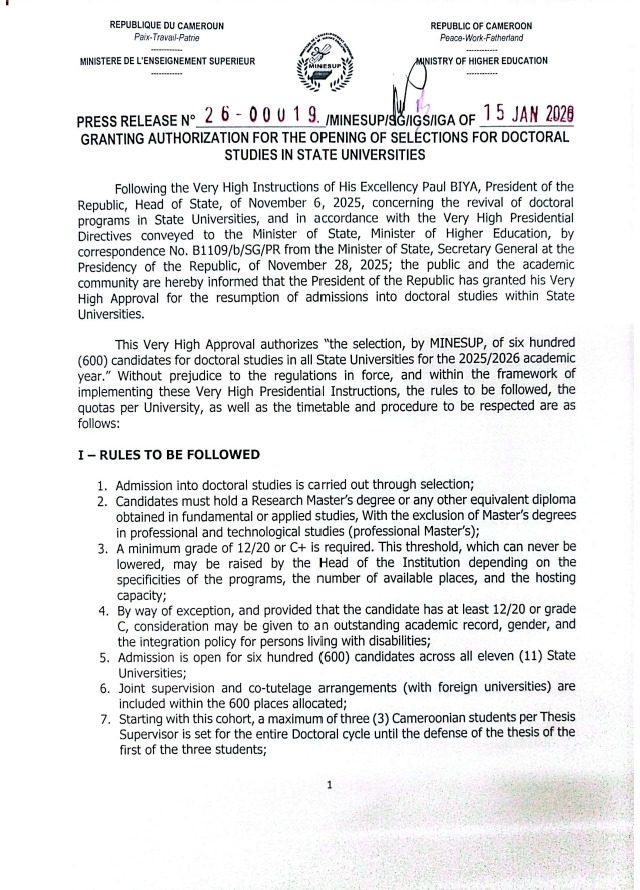
In a landmark move that reaffirms Cameroon’s commitment to knowledge production, innovation, and global academic competitiveness, the President of the Republic, His Excellency Paul Biya, has granted his Very High Approval for the resumption of doctoral admissions in all State Universities. This decision, formalized in Press Release No. 26-00019/MINESUP/SG/IGS/IGA of 15 January 2028, marks a decisive turning point in the nation’s higher education landscape.
Issued by the Ministry of Higher Education (MINESUP), the communiqué follows the President’s high-level instructions of November 6, 2025, calling for the revival of doctoral programmes in public universities. It is also anchored in subsequent presidential directives transmitted through the Secretary General at the Presidency of the Republic on November 28, 2025. Together, these measures constitute a bold strategic intervention aimed at revitalizing advanced research training, strengthening national innovation capacity, and aligning academic production with Cameroon’s National Development Strategy (SND30).
𝟔𝟎𝟎 𝐃𝐨𝐜𝐭𝐨𝐫𝐚𝐥 𝐎𝐩𝐩𝐨𝐫𝐭𝐮𝐧𝐢𝐭𝐢𝐞𝐬 𝐀𝐜𝐫𝐨𝐬𝐬 𝟏𝟏 𝐒𝐭𝐚𝐭𝐞 𝐔𝐧𝐢𝐯𝐞𝐫𝐬𝐢𝐭𝐢𝐞𝐬
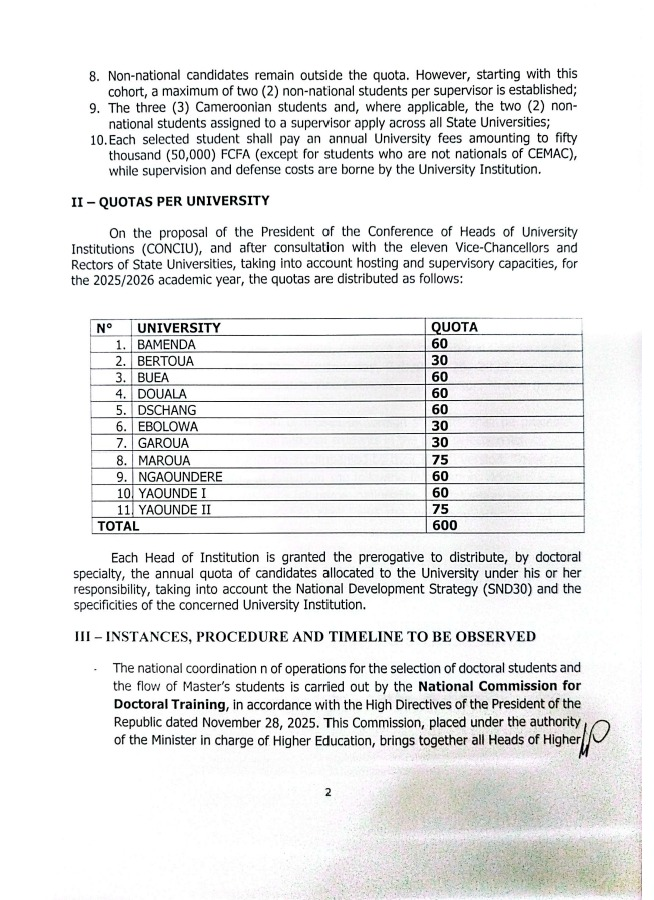
At the heart of this revival is the authorization to select six hundred (600) doctoral candidates for the 2025/2026 academic year across the country’s eleven (11) State Universities. This initiative not only restores access to doctoral education but also introduces a more structured, transparent, and quality-driven framework for admissions.
The distribution of the quotas reflects careful consideration of institutional capacity and supervisory resources. Universities such as Maroua and Yaoundé II have been allocated 75 slots each, while Bamenda, Buea, Douala, Dschang, Ngaoundéré, and Yaoundé I each receive 60. Smaller but strategically significant institutions such as Bertoua, Ebolowa, and Garoua have been allotted 30 slots each—ensuring a more geographically inclusive approach to doctoral training.
𝐌𝐞𝐫𝐢𝐭, 𝐄𝐪𝐮𝐢𝐭𝐲, 𝐚𝐧𝐝 𝐐𝐮𝐚𝐥𝐢𝐭𝐲 𝐚𝐭 𝐭𝐡𝐞 𝐂𝐨𝐫𝐞
Admission into doctoral studies will be strictly by selection, reinforcing meritocracy and academic rigor. Candidates must hold a Research Master’s degree or its equivalent in fundamental or applied studies, with professional and technological Master’s degrees explicitly excluded.
A minimum academic threshold of 12/20 (or C+) has been set, which cannot be lowered—though it may be raised depending on program-specific demands and capacity. In a commendable move toward inclusive excellence, the communiqué also allows for exceptional consideration of outstanding academic records, gender balance, and the integration of persons living with disabilities.
Another significant reform is the regulation of supervision loads. From this cohort onward, a supervisor may oversee a maximum of three Cameroonian doctoral students at a time, ensuring more effective mentorship and quality control. Additionally, up to two non-national students may be supervised per academic, outside the national quota.
𝐀 𝐍𝐚𝐭𝐢𝐨𝐧𝐚𝐥𝐥𝐲 𝐂𝐨𝐨𝐫𝐝𝐢𝐧𝐚𝐭𝐞𝐝 𝐏𝐫𝐨𝐜𝐞𝐬𝐬
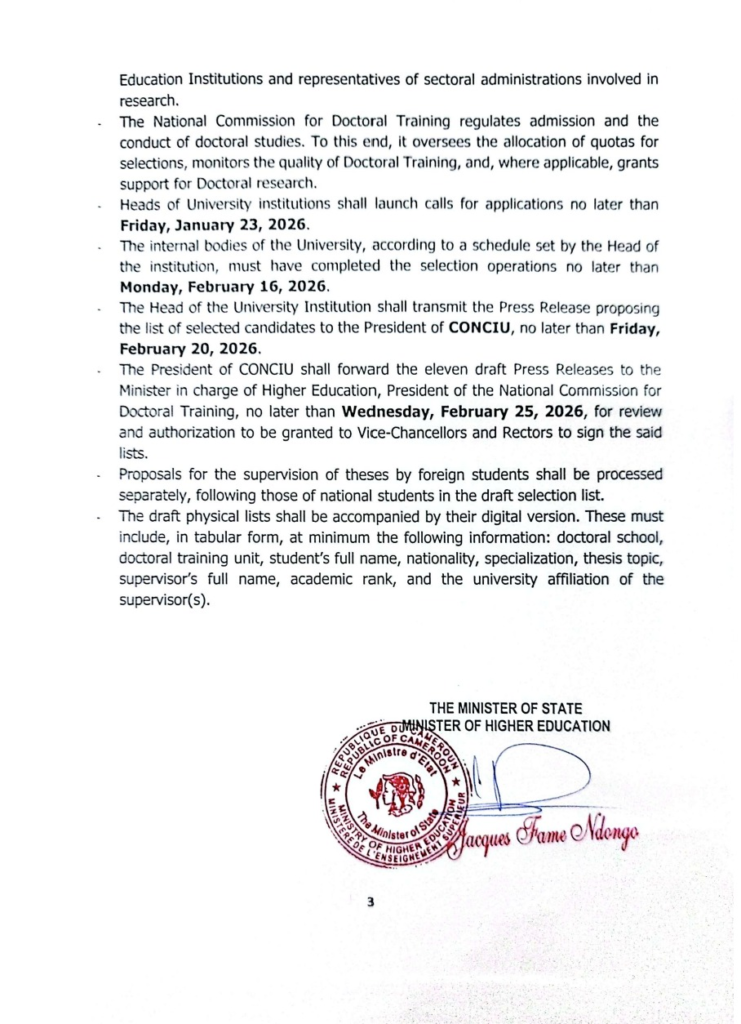
The national coordination of this ambitious initiative will be handled by the National Commission for Doctoral Training, operating under the authority of the Minister of Higher Education. This body brings together all heads of State Universities and relevant sectoral representatives, with a mandate to regulate admissions, ensure quality assurance, and, where possible, facilitate research support.
University heads are required to publish calls for applications by January 23, 2026, with internal selections concluding by February 16, 2026. Final lists will undergo a multi-level validation process involving the Conference of Heads of University Institutions (CONCIU) and MINESUP—ensuring transparency, accountability, and national coherence.
𝐅𝐢𝐧𝐚𝐧𝐜𝐢𝐧𝐠 𝐚𝐧𝐝 𝐈𝐧𝐬𝐭𝐢𝐭𝐮𝐭𝐢𝐨𝐧𝐚𝐥 𝐑𝐞𝐬𝐩𝐨𝐧𝐬𝐢𝐛𝐢𝐥𝐢𝐭𝐲
Each selected student will pay a modest annual fee of 50,000 FCFA (with exemptions for certain international categories), while supervision and thesis defense costs will be borne by the universities themselves. This reflects a strong institutional commitment to research development and student support.
𝐈𝐦𝐩𝐥𝐢𝐜𝐚𝐭𝐢𝐨𝐧𝐬 𝐟𝐨𝐫 𝐂𝐚𝐦𝐞𝐫𝐨𝐨𝐧’𝐬 𝐊𝐧𝐨𝐰𝐥𝐞𝐝𝐠𝐞 𝐄𝐜𝐨𝐧𝐨𝐦𝐲
This decision is not merely administrative; it is deeply symbolic. It signals a renewed national faith in scholarship, critical inquiry, and the transformative power of research. In a world increasingly shaped by ideas, data, and innovation, Cameroon’s reinvestment in doctoral education is both timely and visionary.
At Riverview University Institute (RUI), we view this development as a clarion call for collaboration, mentorship, and research-driven leadership. A nation that invests in its thinkers invests in its future.
This revival of doctoral training must now be matched by robust funding, international partnerships, and a culture of academic integrity. If properly implemented, this initiative could usher in a new generation of Cameroonian scholars—equipped not just to interpret the world, but to change it.
𝑭𝒐𝒓 𝒇𝒖𝒓𝒕𝒉𝒆𝒓 𝒊𝒏𝒔𝒊𝒈𝒉𝒕𝒔, 𝒂𝒄𝒂𝒅𝒆𝒎𝒊𝒄 𝒄𝒐𝒎𝒎𝒆𝒏𝒕𝒂𝒓𝒚, 𝒂𝒏𝒅 𝒑𝒐𝒍𝒊𝒄𝒚 𝒂𝒏𝒂𝒍𝒚𝒔𝒊𝒔 𝒐𝒏 𝒉𝒊𝒈𝒉𝒆𝒓 𝒆𝒅𝒖𝒄𝒂𝒕𝒊𝒐𝒏 𝒓𝒆𝒇𝒐𝒓𝒎𝒔 𝒊𝒏 𝑪𝒂𝒎𝒆𝒓𝒐𝒐𝒏, 𝒇𝒐𝒍𝒍𝒐𝒘 𝑲.𝑲. 𝑩𝒐𝒏𝒕𝒆𝒉 𝒕𝒉𝒓𝒐𝒖𝒈𝒉 𝑹𝒊𝒗𝒆𝒓𝒗𝒊𝒆𝒘 𝑼𝒏𝒊𝒗𝒆𝒓𝒔𝒊𝒕𝒚 𝑰𝒏𝒔𝒕𝒊𝒕𝒖𝒕𝒆 (𝑹𝑼𝑰).